
At Angkor CA, we believe tax planning should be proactive, not reactive. For many of our clients, especially those earning business or investment income, the Pay As You Go (PAYG) instalment system is a key part of managing tax obligations throughout the year.
Whether you're a sole trader in Melbourne, a company director expanding operations, or managing a trust with rental income, understanding how PAYG works can help you avoid surprises and maintain healthy cash flow.
What Are PAYG Instalments?
PAYG instalments are regular prepayments made toward your expected annual income tax liability. Instead of paying a lump sum when your tax return is lodged, you spread your payments across the financial year. This helps smooth out your cash flow and reduces the risk of a large tax bill at year-end.
The system applies to a wide range of entities including sole traders, partnerships, companies, and trusts. If you receive income that has not had tax withheld, such as business profits, investment income, or trust distributions, you may be required to pay PAYG instalments.
Many clients assume PAYG only applies to large businesses. In reality, even modest investment income or side business earnings can trigger the threshold.
When Do PAYG Instalments Start?
The ATO will notify you if you are required to begin PAYG instalments. This usually occurs when:
• Your most recent tax return shows instalment income of $4,000 or more
• Your tax payable exceeds $1,000
• You are not entitled to a full refund of PAYG withheld
Once notified, you will enter the PAYG system from the next quarter. However, you can also opt in voluntarily. Many growing businesses choose to do this to avoid a surprise tax bill later.
For example, a local café owner experiencing seasonal growth may choose to start PAYG early to better manage their cash flow and avoid a spike in tax liability at year-end.
How Are Instalments Calculated?
There are two main calculation methods:
1. Instalment Amount – a fixed dollar amount based on your previous tax return
2. Instalment Rate – a percentage applied to your actual income for the quarter
You can choose the method that best suits your current situation. If your income fluctuates, the rate method may offer more flexibility. You also have the option to vary your instalments if your circumstances change. However, it is important to estimate carefully, as underestimating can lead to interest charges.
We often help clients review their quarterly performance and adjust instalments strategically, especially those in seasonal industries or with variable investment income.
What Should You Do Now?
If you have received a PAYG instalment notice, log in to your myGov or Online Services for Business account to review your obligations. If you have not been notified but expect to earn business or investment income this year, consider whether opting in voluntarily makes sense for your situation.
We recommend:
• Confirming your PAYG status and obligations
• Choosing the most suitable calculation method
• Reviewing your cash flow to ensure you are prepared for each instalment
Final Thoughts from Angkor CA
PAYG instalments are designed to make tax management easier and more predictable. At Angkor CA, we help clients across Melbourne and beyond navigate PAYG with clarity and confidence.
If you are unsure about your PAYG position or want to plan ahead for upcoming instalments, we are here to support you. Let us help you make informed decisions and keep your business financially resilient throughout the year.
📞 Call Us: 1300 888 168
✉️ Email Us: info@angkorca.com.au
PAYG Instalments: A Practical Guide for Business Owners

Maximising Rental Property Deductions: Practical Tax Insights for Australian Property Owners
At our firm, we know that owning a rental property can be both a rewarding investment and a complex financial responsibility. Navigating the ins and outs of rental income and deductions isn’t always straightforward, but understanding what you can legally claim is essential to maximising your return and remaining compliant with the Australian Taxation Office (ATO).
Here’s a breakdown of what landlords need to know, along with insights from our team to help you avoid common pitfalls and optimise your position.
All Rental Income Must Be Declared
No matter how your rental income is generated, the ATO expects full disclosure. This includes:
• Rent received from tenants
• Retained bond money for damage or unpaid rent
• Insurance payouts related to the rental
• Expense reimbursements (e.g., water, utilities)
• Government grants or rebates
• Earnings from short, term rental platforms (like Airbnb or Stayz)
Tip from our team: Many clients overlook income from short, term arrangements or casual holiday lets. Remember, even one, off earnings must be declared in the financial year they’re received.
What You Can Claim as a Deduction
Claiming valid deductions can significantly reduce your taxable income. Common deductible items include:
1. Interest on Loans – You can deduct the interest on loans used to buy, renovate, or maintain the rental (principal repayments are not deductible).
2. Council Rates & Water Charges – If paid by the landlord, these are claimable.
3. Repairs vs. Improvements – Immediate deductions apply to tenant, caused damage or wear and tear. However, major upgrades (like a kitchen remodel) are capital works and must be depreciated over time.
4. Property Management Fees – Including agent commissions, advertising, and legal lease, related costs.
5. Depreciation – Applicable to assets like hot water systems and dishwashers, using a professional depreciation schedule.
6. Insurance Premiums – Building, contents, and landlord insurance are all deductible.
7. Travel Costs – Since 1 July 2017, travel expenses for individual landlords are generally non, deductible, exceptions may apply for corporate entities.
8. Maintenance Expenses – Pest control, cleaning, and gardening, as long as directly related to rental operations.
Client reminder: Mixing repairs with renovations is a common trap. If you replace a worn carpet, that’s maintenance, but if you install hardwood flooring, that’s an upgrade. Documentation and timing matter here.
Capital Improvements vs. Repairs
Distinguishing between deductible repairs and capital improvements is crucial. Upgrades such as new kitchens, garages, or decks fall under capital works, which are claimed gradually over several years, don’t expect immediate tax relief.
Rental Use Period Matters
If your rental was only leased part of the year or used personally at any point, deductions must be proportionate. The same applies to partial rentals like granny flats or individual rooms in your home.
Real, world example: If your investment property in Geelong was vacant for three months, expense claims need to reflect that reduced rental period.
Good Records Keep You Safe
The ATO requires landlords to keep income and expense records for at least five years. Contracts, receipts, and bank statements aren’t just useful, they’re vital if your claims are ever audited.
Expert Insight: In our experience, clients who maintain detailed digital records are far less likely to face ATO scrutiny. We recommend scanning and tagging receipts for easy access and review.
Your Next Step
Rental properties can be a powerful wealth, building tool, but the tax rules are detailed, and small errors can lead to costly consequences. If you're unsure about a deduction or want help organising your records, our team is here to guide you every step of the way.
Let’s make sure your investment works smarter for you this financial year. Contact us to discuss your rental deductions, accurately, compliantly, and confidently.
📞 Call Us: 1300 888 168
✉️ Email Us: info@angkorca.com.au

Considering Downsizer Contributions? Here’s What You Should Know
For clients aged 55 and over, selling the family home could offer more than just a change of scenery, it could be a powerful opportunity to strengthen your retirement strategy. Through the downsizer contribution scheme, eligible individuals can invest proceeds from the sale directly into superannuation, helping boost long-term financial security.
At Angkor CA, we help clients turn complex regulations into confident decisions. Here’s how this strategy works, and why it might be worth considering.
What Is a Downsizer Contribution?
A downsizer contribution allows eligible Australians aged 55+ to contribute up to $300,000 from the sale of their main residence directly into superannuation. For couples, that’s up to $600,000 combined. This contribution doesn’t count toward your standard concessional or non-concessional contribution caps, making it a rare chance to move substantial funds into a tax-effective environment.
We often see retirees who’ve sold properties in Melbourne or regional centres unsure about what to do next with the proceeds, this measure gives clarity and structure to that transition.
Who Can Make a Downsizer Contribution?
To qualify, you must meet these criteria:
• Age: You must be 55 or older at the time you make the contribution.
• Ownership: The home must have been your primary residence and owned for at least 10 years by you or your spouse.
• Capital Gains Tax: It must be eligible for full or partial exemption under the main residence exemption.
• Timing: The contribution must be made within 90 days of receiving the sale proceeds (usually settlement).
• Limit: It’s a one-time opportunity. $300,000 per person, once only.
It’s critical that clients don’t miss the 90-day deadline. We’ve had cases where late action led to rejected contributions, planning early can save headaches later.
Key Benefits
• Boost Your Super: Move significant funds into super, without breaching contribution caps.
• Tax-effective Growth: Superannuation offers favourable tax treatment, especially post-retirement.
• Investment Choice: Allocate your contribution across a wide range of assets within your super fund.
• Estate Planning: Consolidating funds in super may simplify your future financial arrangements.
How to Make the Contribution
1. Sell your eligible property, and confirm it meets criteria.
2. Complete the ATO Downsizer Contribution Form.
3. Submit the form to your super fund, before or when making the contribution.
4. Transfer the funds within 90 days of settlement.
Tip: Don’t wait until settlement day to begin prep, get advice as early as the listing phase.
Important Considerations
This opportunity comes with some caveats:
• Centrelink Impact: Once in super, the funds count towards your assets/income tests. This may affect Age Pension entitlements.
• Super Access: Depending on your retirement status, funds may not be accessible immediately.
• Strict Deadlines: Late contributions are rarely accepted, timing is everything.
Let’s Make Your Retirement Strategy Work Harder
Selling your home is a major milestone, and downsizer contributions can help convert real estate equity into long-term retirement value. But the rules are strict and the process needs care.
If you're thinking about making a downsizer contribution, speak to our team before you sell. We'll guide you through eligibility, ensure ATO compliance, and help tailor the strategy to your retirement goals.
📞 Call Us: 1300 888 168
✉️ Email Us: info@angkorca.com.au
Tax Time Tips: Smart Deductions to Know for 2024–25
As we close out the 2024–25 financial year and look ahead to 2025–26, many Australians are gearing up for that annual ritual: tax return prep. Whether you're an early bird lodging your return now or plan to file closer to October, knowing exactly what you can claim and what might trip you up is key to making the most of your refund.
At our firm, we work closely with individuals and business owners to make sure they don’t miss out on legal deductions or fall into common traps. Here’s a breakdown of the major claims you may be eligible for this year.
1. Work-Related Expenses
If you're spending money to earn money, some costs may be deductible, so long as they’re not reimbursed and are directly tied to your role.
• Home Office Costs: Remote and hybrid work is still going strong. You may qualify to claim internet, electricity and equipment depreciation using the fixed rate method (70c/hour). Just remember: documentation is everything.
• Tools & Uniforms: Required uniforms, protective gear, and laundry costs are often overlooked but claimable.
• Training: Upskilling for your current job? Expenses for approved education, travel, and materials might be deductible as long as the course doesn’t lead to a new career.
2. Travel & Vehicle Use
Driving for work (not your daily commute) could mean a claimable deduction. The cents-per-kilometre rate is 88c/km for 2024–25. Maintain a logbook or diary to prove your usage.
Note: Travel between home and one regular workplace is not deductible, unless you're moving between sites or transporting heavy tools.
3. Donations That Count
If you’ve donated $2 or more to a registered charity with DGR status, you can claim it, just hold onto that receipt.
4. Costs of Managing Your Tax Affairs
Engaging a registered tax agent like us? Fees for preparing your return are tax-deductible, along with related costs like travel to your appointment and subscriptions to tax publications.
5. Investment-Related Expenses
If you're earning income from investments, certain costs may qualify:
• Interest on loans used for investing
• Property repairs, maintenance, and depreciation
• Financial advice and management fees
Just remember: deductions must relate to income-generating periods, not future gains.
Why Professional Advice Pays Off
The ATO has sophisticated data matching tools, and small errors can create big headaches from audit flags to refund delays. Software is helpful, but doesn’t replace nuanced, personalised advice, especially if your circumstances have shifted.
We're here to:
• Identify all valid deductions for your situation
• Minimise audit risk with compliant claims
• Help you plan ahead for 2025–26
Tax rules change fast, what was deductible last year may not be this year. If you're seeking clarity, accuracy and a better outcome, book your appointment with our team today.
📞 Call Us: 1300 888 168
✉️ Email Us: info@angkorca.com.au

What to Do from 1 July: Kick Off the New Financial Year with a Bang🎄
The start of a new financial year presents the perfect opportunity to reset, refocus, and set your business up for success.
As your accountant, we recommend treating 1 July not just as a date on the calendar, but as a strategic launchpad for the year ahead.
Here’s how to make the most of it:
1. Update Your Financial Records and Systems
Start fresh by ensuring your accounting software is rolled over to the new financial year.
Reconcile your books, clear any outstanding transactions, and archive your end-of-year records. This helps avoid confusion and ensures clean, accurate reporting from day one.
Review your chart of accounts and reporting categories — they may need tweaking to reflect your business’s current goals better.
2. Review and Reset Your Budget
Take the time to review your past performance and set a realistic, informed budget for the new financial year. Factor in both fixed and variable costs, expected revenue, and any anticipated growth or investment areas.
A well-prepared budget helps you track progress, make timely decisions, and avoid unnecessary cash flow pressures.
3. Revisit Your Business Plan and Strategy
Is your business still moving in the direction you want it to?
Use this opportunity to revisit your goals, marketing strategies, and growth plans. If you’ve been operating without a documented business plan, now is the time to formalise it.
4. Check Compliance and Key Thresholds
From 1 July, various tax thresholds, award rates, and superannuation rules may change. For example, the super guarantee rate will increase to 12% from 1 July 2025. Ensure your payroll systems are updated to reflect this and any other relevant legislative changes. Review your obligations for PAYG withholding, BAS lodgements, and STP reporting.
5. Set KPI Targets
Establish measurable key performance indicators (KPIs) for your business, such as profit margins, customer retention, lead generation, or productivity. Setting targets early keeps you focused and helps you identify issues before they grow.
6. Assess Your Staffing and HR Needs
Evaluate whether your current team structure supports your goals. Are you looking to hire? Do your current team members need training or development? Review award changes and ensure all employment contracts and leave balances are up to date.
7. Update Your Risk Management
Ensure all business insurances (including public liability, cyber, and professional indemnity) are current and still appropriate for your risk profile. Review your data security and privacy procedures, especially if you store customer or employee information.
8. Engage with Your Accountant Early
Don’t wait for tax time to ask questions. Discuss tax planning, cash flow forecasting, business structure, or financing options with us early on. Getting proactive advice now can lead to significant savings and smarter decisions in the future.
By acting early in the financial year, you give your business the best possible chance to thrive.
Taking a proactive, strategic approach from 1 July helps build momentum, keeps your financials in order, and sets the tone for a strong and prosperous year ahead.
As always, we’re here to help you every step of the way. Start a conversation with us to find out how.
📞 Call Us: 1300 888 168
✉️ Email Us: info@angkorca.com.au

Vacant Residential Land Tax Changes 2025 🎄
Important for property owners in Victoria. Starting 1 January 2025, the Vacant Residential Land Tax (VRLT) will apply to all vacant residential properties across Victoria—not just inner and middle Melbourne.
From 1 January 2025
VRLT may apply to:
• Residential land with an existing home on it that is vacant for more than 6 months in the calendar year preceding the tax year
• Residential land with a home on it that has been under construction or renovation for 2 years or more
• Residential land with a home on it that has been uninhabitable for 2 years or more.
Certain exemptions may apply.
What You Need to Do:
• If your property has been vacant for more than six months, you must notify the State Revenue Office by 15 January 2025. This notification is mandatory even if you are claiming an exemption.
• We suggest you visit the State Revenue Office Victoria website for more information.
Connect with us today and discover how we can help you save big on taxes while staying compliant.
📞 Call Us: 1300 888 168
✉️ Email Us: info@angkorca.com.au
Boxing Day Planning! 🎄
While Boxing Day will be a fun day full of sales, sports, and time with loved ones, let’s also chat about how to make the most of your tax deductions. Ready to save some money? Let’s go!
📅 Boxing Day Sales: Are you hitting up those sales? Remember, items like office supplies, electronics, and even work-related clothing can be tax deductible.
💻 Business Security: If you’ve been thinking about leveling up the privacy and security of your business, Boxing Day deals on antivirus software, VPNs, and password managers are worth checking out. These expenses can often be claimed as deductions.
📚 Self-Education: Looking to boost your skills? Online training and education courses might be on sale. Investing in your professional development can also be tax-deductible if it’s related to your current job.
📝 Pro Tip: Don’t buy anything solely for tax deduction purposes, as you will still be out of pocket. Use apps or digital tools to organise and store your receipts for easy access.
Enjoy shopping smart and don’t forget to keep all records for tax deductions! For personalised advice, feel free to reach out to us. ✨
Connect with us today and discover how we can help you save big on taxes while staying compliant.
📞 Call Us: 1300 888 168
✉️ Email Us: info@angkorca.com.au
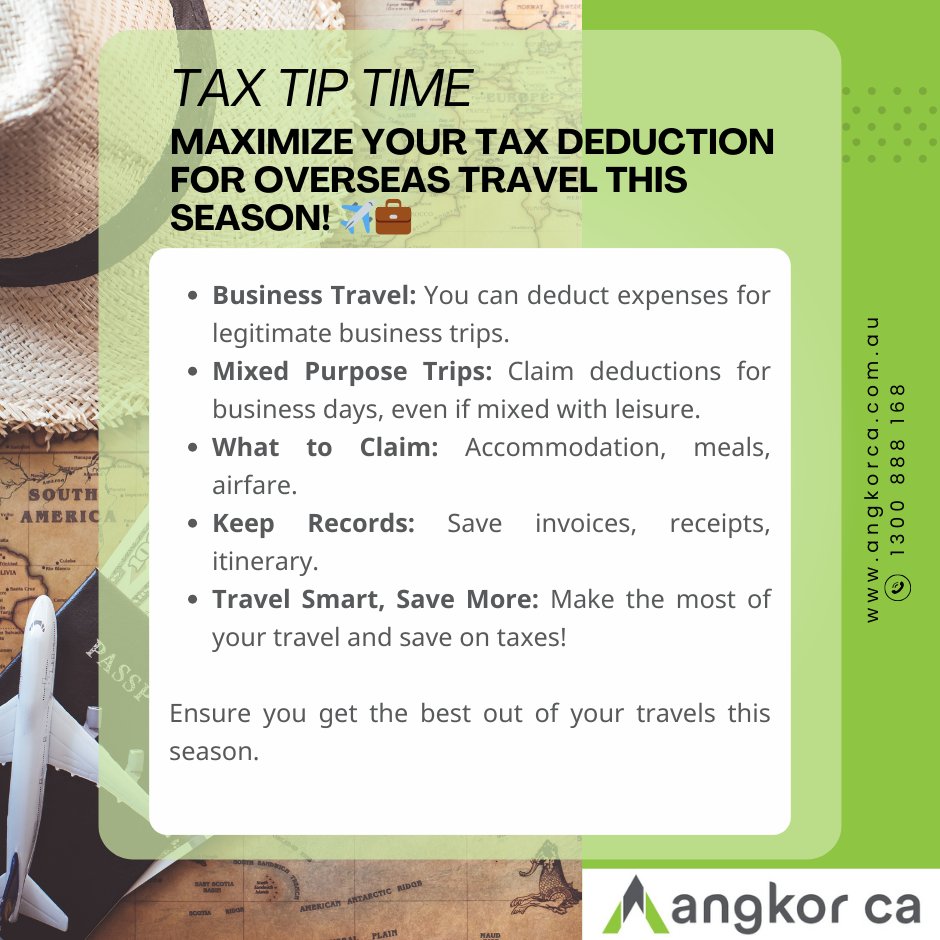
Maximize Your Tax Deductions for Overseas Travel This Season!
Maximize Your Tax Deductions for Overseas Travel This Season!
It's travel season, and if you're a business owner or professional, you can turn your overseas trips into tax-saving opportunities. Here's how you can get the best out of your travels:
Deductible Business Travel: Overseas travel expenses can be deductible if the trip's primary purpose is business-related. Think market research, expanding professional knowledge, or attending business meetings.
Mixed-Purpose Trips: Even if your trip combines business with leisure, you can still claim deductions for the business portion. For example, on a 10-day trip with 8 days of business activities and 2 days of sightseeing, you can claim deductions for accommodation, food and meals etc. for the 8 business days. Certain deductions such as airfare can be claimed in full if the primary purpose is business related.
Record Keeping is Key: Keep detailed records like invoices, receipts, duration of stay, and flight tickets to substantiate your claims.
Remember, it's vital to have proper documentation to support your deductions. Travel smart, save on taxes, and make the most of your travel adventures.
Connect with us today and discover how we can help you save big on taxes while staying compliant.
📞 Call Us: 1300 888 168
✉️ Email Us: info@angkorca.com.au

Hosting the Ultimate Christmas Party Without Breaking the Bank!
Hey Business Owners! Ready to throw the best Christmas party for your team and make it tax-deductible? Let's jingle all the way to some savings! 🎅💼
1. Location, Location, Location: Host your festive bash at the office during a workday. It’s a win-win—tax-deductible and no need to book a venue!
2. Simple, But Delightful: Keep it light with meals, snacks, and non-alcoholic drinks. Everyone loves finger food, right?
3. Employee-Only Vibes: Invite just the employees. Trust us, it keeps things cozy and compliant!
4. No Alcohol: Skip the booze to ensure the event remains tax-deductible. Cheers to that!
But hey, if you want to throw a more extravagant shindig offsite and include everyone’s plus-ones, go for it! Just remember:
• Keep it under $300 per head (including GST), and FBT won't apply. Spend more? It’s still a great party, just subject to FBT. 🎁
Gift-Giving Tip:
• Non-entertainment gifts (like hampers or gift cards) under $300 are FBT-free!
Checklist:
• Save all receipts.
• Keep each employee’s cost under $300.
• Document where and when the party happens.
🎁✨ Celebrate, deduct, and enjoy! Here’s to a fantastic festive season filled with joy and savings! 🌟🎉
Connect with us today and discover how we can help you save big on taxes while staying compliant.
📞 Call Us: 1300 888 168
✉️ Email Us: info@angkorca.com.au